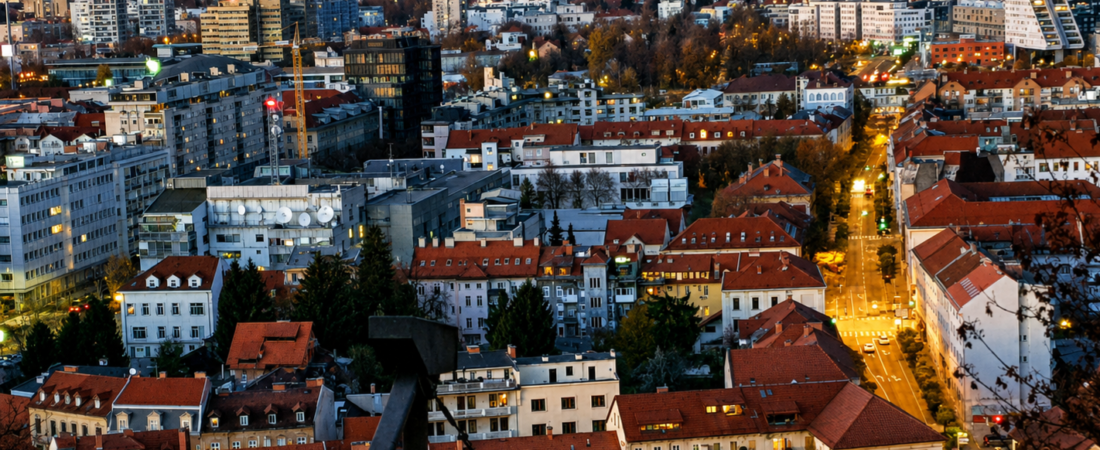
Slovenia’s Capital and One of Europe’s Most Liveable Cities
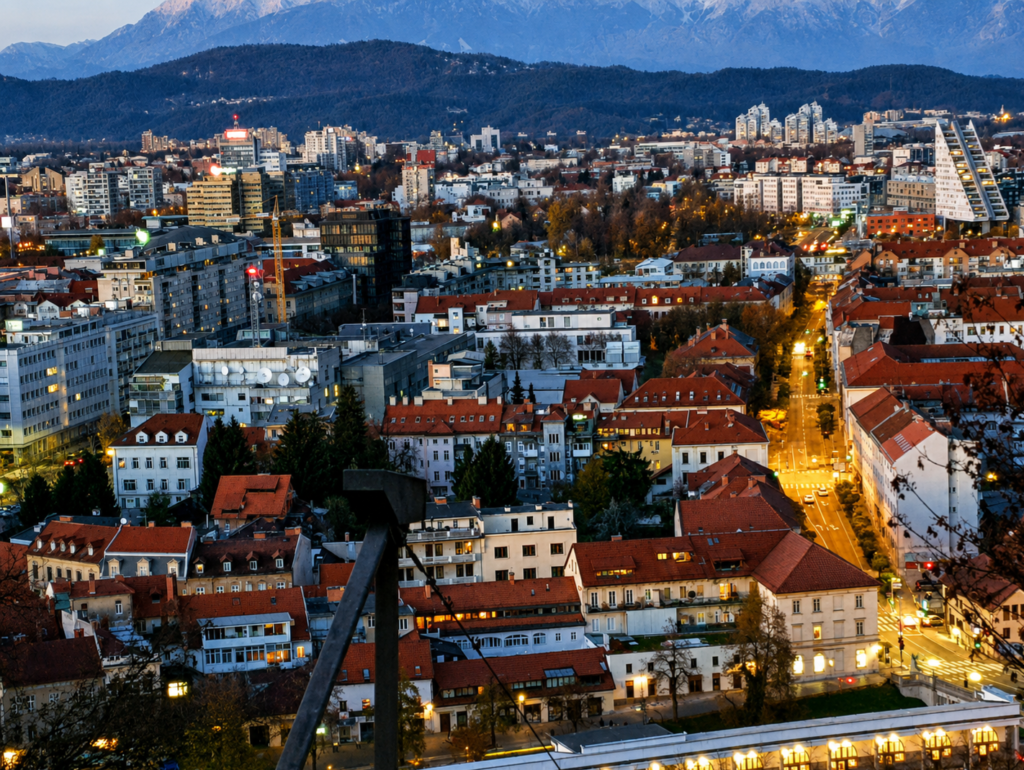
Ljubljana (pronounced roughly LOOB-lee-AH-nah) is the capital and largest city of Slovenia, a compact and elegant city of approximately 285,000 people set in a broad basin between the Julian Alps to the north-west and the Karst Plateau to the south-east. It is, by European standards, an exceptionally liveable city: pedestrian-friendly, green, architecturally unified and possessed of a cultural life that punches far above its size. For visitors arriving from busier capitals elsewhere in Europe, Ljubljana often produces the same reaction – a kind of quiet surprise that something this good could have remained so consistently underrated for so long.
The city owes much of its present character to a single figure: the architect Jože Plečnik (1872–1957), who transformed Ljubljana between the 1920s and 1950s with a body of work that ranges from bridges and market buildings to lamp posts and park furniture. Plečnik’s contribution is now recognised as a UNESCO World Heritage Site, and the evidence of his vision is visible on almost every significant street in the city centre. The triple-arched Triple Bridge, the covered Central Market, the National and University Library, Tivoli Park’s main promenade, and hundreds of smaller interventions combine to create an urban fabric of unusual coherence and humanity.
Ljubljana also serves as the practical hub for exploring Slovenia as a whole. The international airport is 26 kilometres to the north, the main road and rail networks radiate from the city in every direction, and day trips to Lake Bled, Postojna Cave, Predjama Castle and the Slovenian coast are all feasible from a base in the capital. For a visitor spending a week in Slovenia, two or three days in Ljubljana – exploring the old town, the castle, the river, the markets and the food scene – followed by excursions into the surrounding regions provides one of the best introductions to the country available.
Location: Central Slovenia, Ljubljana Basin
Coordinates: 46°03′N 14°30′E
Type: National capital
Country: Slovenia
Population: approximately 285,000 (city); 550,000 (metropolitan area)
Elevation: 298 m above sea level
River: Ljubljanica
Founded: Roman city of Emona, approximately 14 BC
UNESCO Heritage: Plečnik’s Ljubljana (World Heritage Site, 2021)
Location, Landscape & History
Ljubljana sits at the geographic and administrative centre of Slovenia, positioned where the Ljubljana Moors (Ljubljansko barje) – a broad, partially drained wetland basin – meet the lower foothills of the Julian Alps and the eastern edge of the Karst Plateau. The Ljubljanica River flows through the heart of the city in a slow, canal-like course that gives the old town much of its character and provides the setting for the celebrated riverside cafés and restaurants that define Slovenian urban life at its most attractive.
The site has been occupied continuously for at least 6,000 years. Pile-dwelling settlements on the Ljubljana Moors, now recognised as part of a UNESCO World Heritage Site covering prehistoric pile dwellings across the Alps, document human habitation here during the Neolithic and Bronze Ages. Archaeological excavations have recovered the oldest known wooden wheel with an intact axle from these wetland deposits – an artefact now displayed in the Ljubljana City Museum and dated to approximately 3100 BC.
The Romans established a legionary fortress and later a civilian town here under the name Emona (or Aemona) around 14 BC, during the reign of Emperor Augustus. Emona was a substantial settlement covering around 24 hectares and housing perhaps 5,000 to 6,000 inhabitants at its height, connected to the wider Roman road network and positioned at an important junction on routes between the Adriatic coast and the Danubian provinces. The remains of Emona are visible in several locations throughout the modern city, most accessibly in the outdoor Roman Wall Museum (Rimski zid) on Mirje Street where a reconstructed section of the original Roman perimeter wall and towers stands in a small park.
After the collapse of Roman authority, the site passed through successive periods of Ostrogothic, Byzantine, Lombard and Frankish control before the arrival of Slavic tribes during the 6th and 7th centuries established the cultural and linguistic foundation of the community that would develop into medieval Ljubljana. The town first appeared in written records in the early 12th century, though the name Laibach – used in German, the administrative language of the Habsburg Empire – became the form under which the city was internationally known for several centuries.
Habsburg rule, which lasted from 1278 until the dissolution of the empire in 1918, shaped the city profoundly. The medieval castle on the hill above the old town was repeatedly rebuilt and expanded. The Baroque architecture that characterises much of the cathedral quarter and the streets nearest the castle hill dates from the 17th and 18th centuries. The earthquake of 1895, which damaged or destroyed much of the historic centre, paradoxically led to the city’s architectural renewal: the mayor at the time, Ivan Hribar, used the reconstruction as an opportunity to engage architects working in the Vienna Secession and Art Nouveau traditions, producing a wave of new buildings that gave the lower town its present elegant character.
Slovenian independence in 1991 concluded what had been a remarkably peaceful transition from Yugoslav republic to independent nation, and Ljubljana’s rapid development as a European capital in the following decades – joining the EU in 2004, adopting the euro in 2007, hosting major European events and receiving the title of European Green Capital in 2016 – transformed its international profile without fundamentally altering the atmosphere of the old town and riverside that most visitors come to experience.
The Old Town and Plečnik’s Ljubljana
The heart of Ljubljana is best understood as two overlapping cities: the medieval old town that climbs the castle hill, and Plečnik’s 20th-century city that transformed the riverbanks, markets and public spaces below it into something unusually unified in its design sensibility.
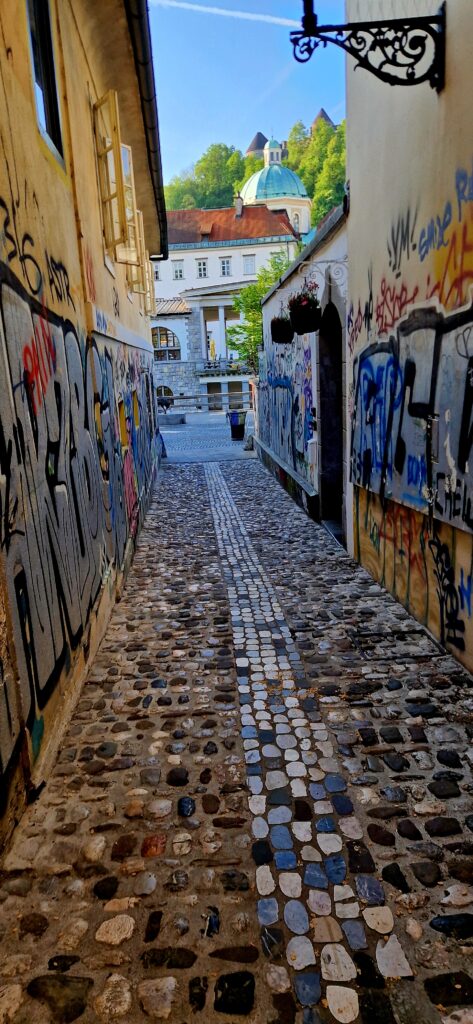
Prešeren Square (Prešernov trg) is the conventional starting point for exploring Ljubljana. The square is named for France Prešeren (1800–1849), the national poet whose image appears on the Slovenian two-euro coin, and his bronze monument stands in the centre of the square facing the pink Baroque facade of the Franciscan Church of the Annunciation. The church’s interior contains frescoes by Giulio Quaglio and a main altar designed in part by Francesco Robba, whose work appears throughout the city.
Directly across the Ljubljanica River from Prešeren Square, the Triple Bridge (Tromostovje) is Plečnik’s most famous single intervention in the city. The original central bridge dates to 1842, but Plečnik added the two flanking pedestrian bridges in 1929, transforming a functional crossing into a public space that manages simultaneously to accelerate and accommodate the movement of the city’s pedestrian traffic. The balustrades, lamp posts and stone detailing of the bridge are characteristic of Plečnik’s approach – functional elements elevated through the application of classical references that never feel pedantic.
Crossing the Triple Bridge leads to the Central Market area, where Plečnik designed the covered market building along the river embankment between 1939 and 1944. The colonnade along the Ljubljanica provides one of the finest pieces of urban streetscape in the city – a covered walkway at the water’s edge that houses fishmongers, delicatessens and small restaurants at ground level, with market storage and service functions above. The outdoor market extends onto Vodnikov Square beyond, with fresh produce, flowers, cheese, honey and locally made goods available daily except Sundays.
Ljubljana Castle
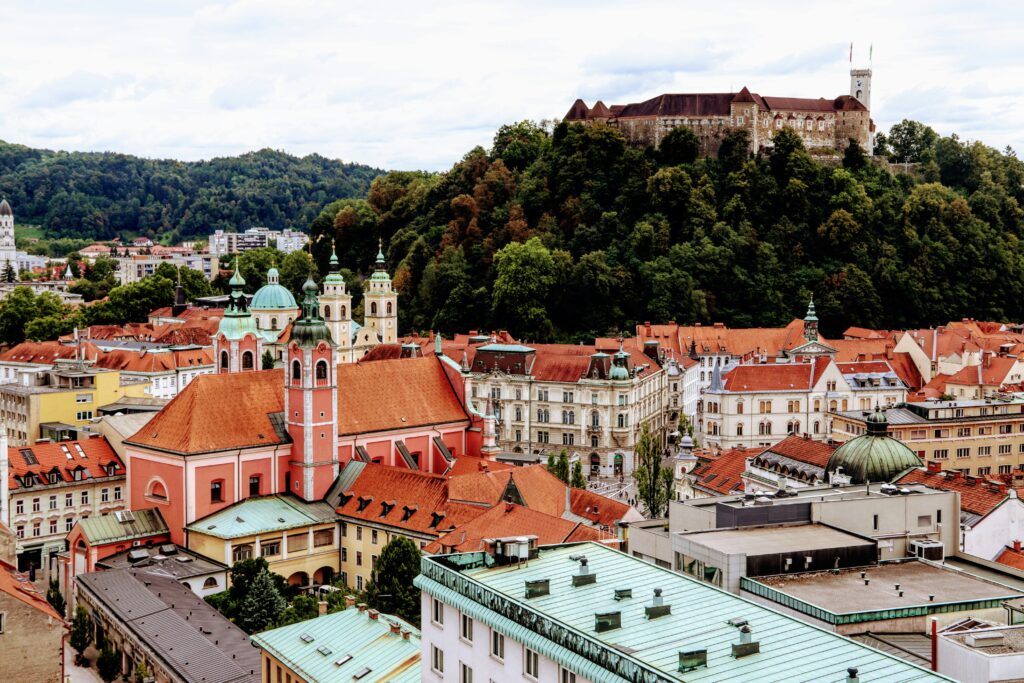
The castle hill rises directly above the old town, its fortifications visible from most of the city centre and accessible on foot in approximately 15 minutes from the old town, or in under 2 minutes by the funicular railway that departs from Krekov trg 4 below. The funicular is the more enjoyable way to arrive, ascending through a glass-sided car that offers upward views of the castle walls and downward views of the old town rooftops during the brief ascent.
The history of the site extends at least to the 11th century, when a fortification is first recorded here, though the strategic importance of the hill above the Ljubljana Basin suggests earlier military occupation. The current castle buildings date primarily from the 15th and 16th centuries, with significant restorations and additions made during the 20th century following periods of use as a barracks, a prison and a poorhouse that left the medieval structures in poor condition by the early 20th century.
Today the castle houses the Slovenian History Museum, which presents the country’s history from prehistoric pile dwellings to independence through well-curated permanent displays that provide essential context for understanding the country beyond its natural scenery. The Museum of Puppetry reflects Slovenia’s distinguished tradition in the performing arts. The Castle Chapel of St George, one of the oldest surviving structures on the hill, contains heraldic frescoes of Carniolan noble families dating from the early 16th century.
The Viewing Tower at the castle summit requires additional steps but delivers the most comprehensive panorama available anywhere in the city – Ljubljana’s red-roofed old town, the Ljubljanica River, the tree-lined streets of the Plečnik city, the mountain horizon of the Karavanke and, in clear conditions, the snow-capped summits of the Julian Alps to the north-west.
The Bridges
Three bridges within a few hundred metres of each other give the central Ljubljanica its distinctive character and are among the most visited points in the city.
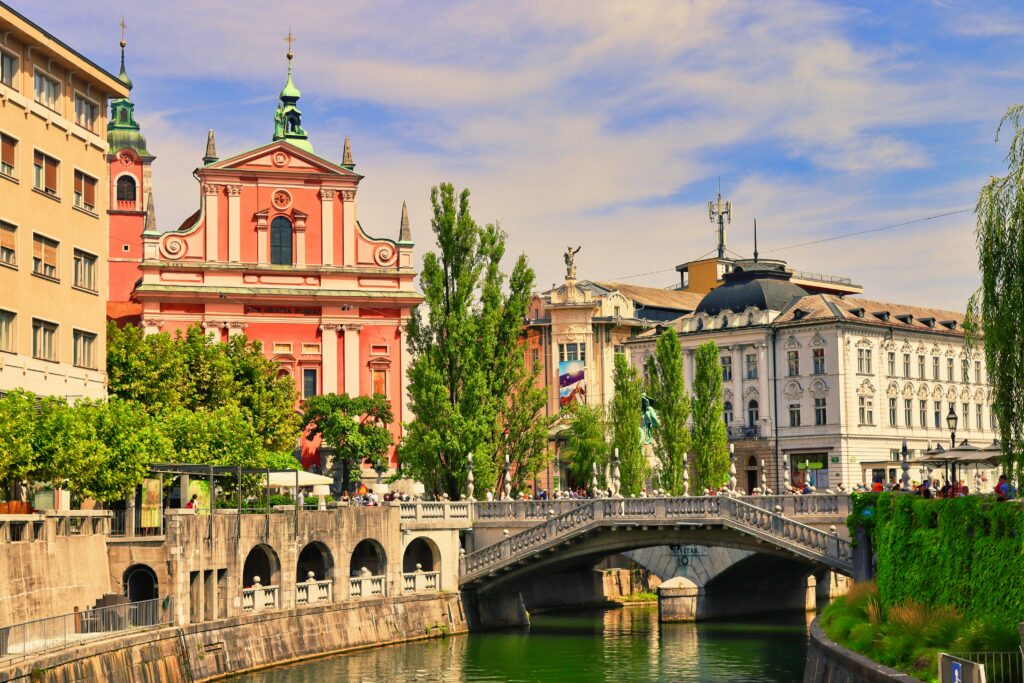
The Triple Bridge has already been described. Immediately downstream, the Butcher’s Bridge (Mesarski most), completed in 2010, is Ljubljana’s contemporary contribution to the bridge tradition: a glass-sided pedestrian structure that has accumulated thousands of love locks on its steel cables since opening and displays bronze sculptures by the artist Jakov Brdar – including a striking male figure of unusual anatomical candour – that provoke rather more conversation than the bridge itself.
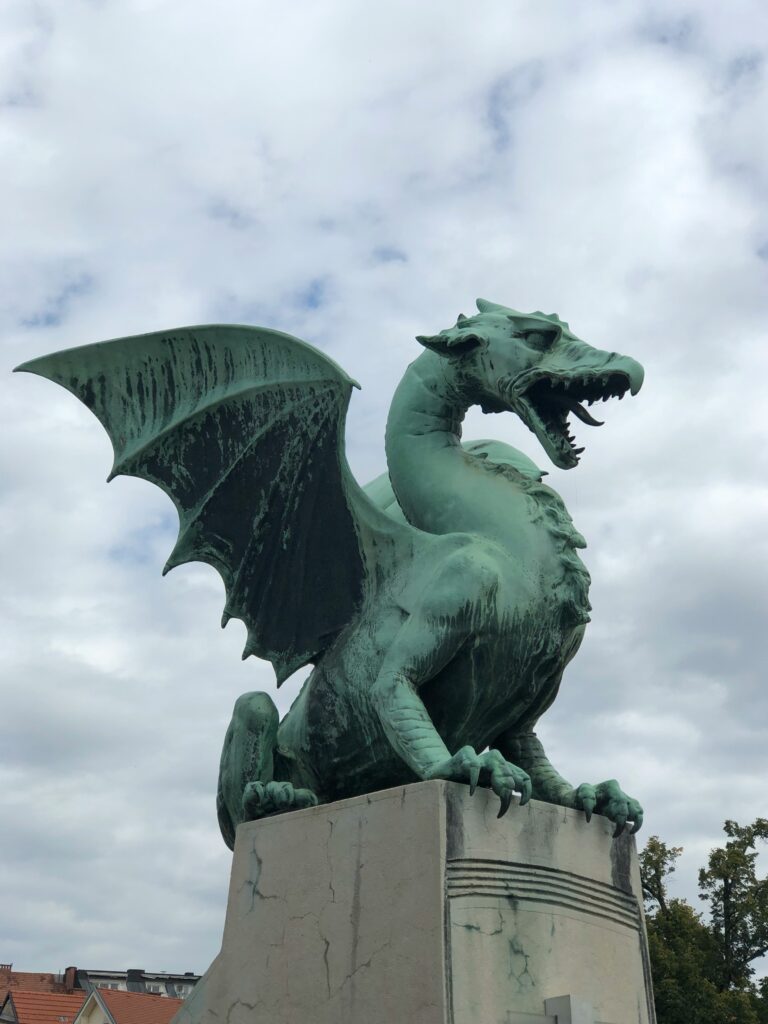
Further downstream, the Dragon Bridge (Zmajski most), completed in 1901 in the Vienna Secession style, is flanked by four copper dragons mounted on its corners – the city’s heraldic animal, derived from the legend of Jason and the Argonauts, who according to Slovenian folk tradition slew a dragon in the Ljubljana Marshes during his return from Colchis. The dragons have become the defining symbol of Ljubljana and appear on the city’s coat of arms, its flags and virtually every piece of tourist merchandise. On Ljubljana’s national holiday (Cityhood Day, 25 October), the dragon bridge illuminates in particular colours that mark the occasion.
The Ljubljanica River and Green Ljubljana
Ljubljana takes its relationship with the natural environment more seriously than almost any comparable European capital. The city was named European Green Capital in 2016 by the European Commission in recognition of its environmental policies, its green infrastructure and its commitment to sustainable urban development. Since 2011, private vehicles have been banned from the entire historic city centre, a decision that has transformed the old town into a genuinely pedestrian environment where the ambient noise level is defined by conversation, bicycle bells and the flow of water rather than traffic.
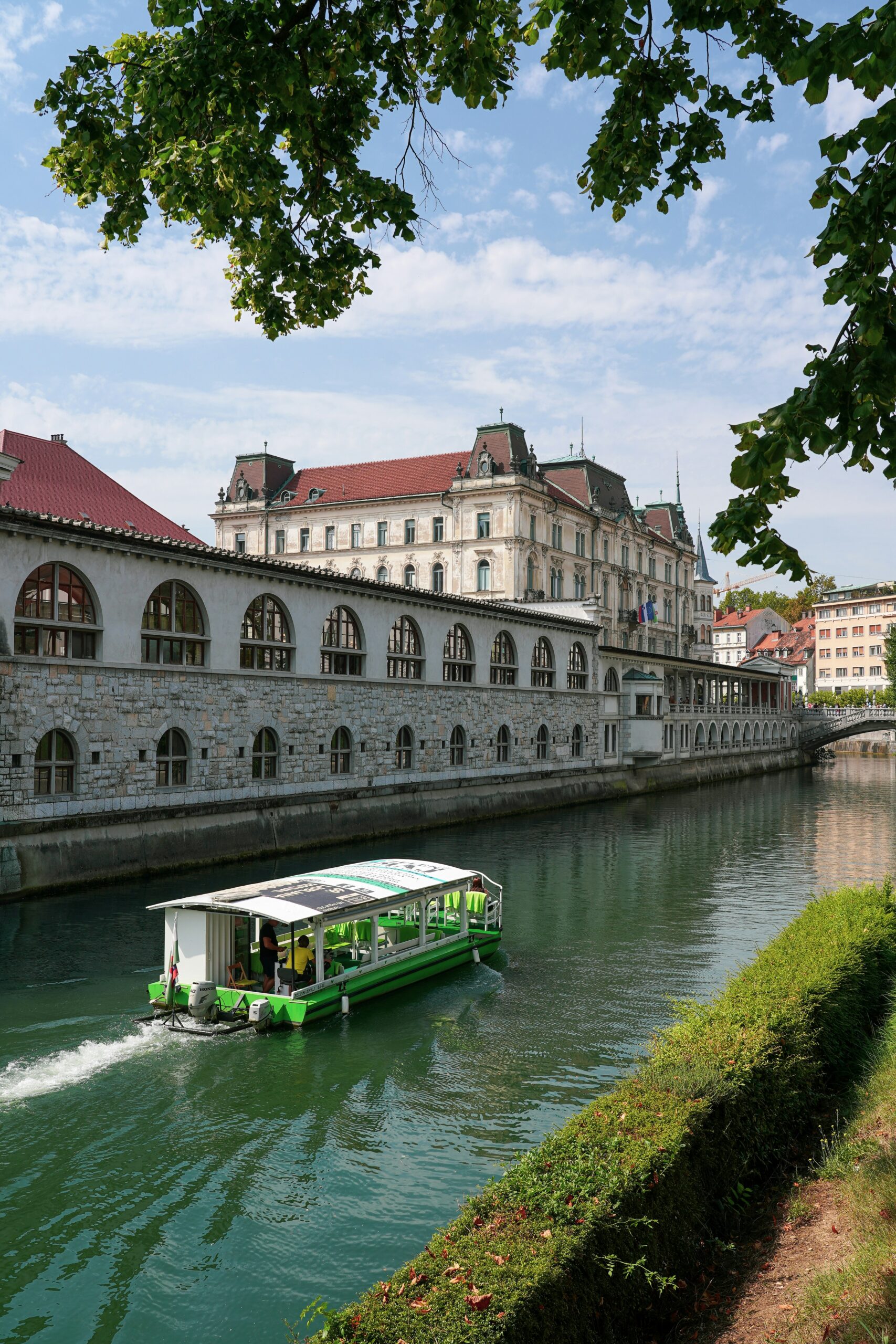
The Ljubljanica River is the backbone of this pedestrian city. A network of riverside paths, embankments and cafés follows both banks through the city centre, and the summer occupation of these spaces by residents and visitors – eating outdoors, drinking coffee at stone-edged embankment tables, watching kayakers navigate the urban river – represents Ljubljana at its most characteristic.
Boat cruises on the Ljubljanica operate throughout the main tourist season from a dock below Ribja Bridge, covering approximately 5 kilometres of the river in a 45-minute circuit that passes under all the famous bridges and through sections of the city that are difficult to appreciate from the embankment level.
Tivoli Park, the city’s largest green space, covers approximately 5 square kilometres immediately west of the centre and contains the main promenade (designed by Plečnik), several museums and galleries, sports facilities, a mini-golf course, a small zoo, and extensive woodland trails that continue up the slopes of Rožnik Hill beyond the formal park boundaries. The park is used continuously by Ljubljana residents for morning runs, afternoon walks and evening cycling, and its scale makes it feel like a genuine escape from the city rather than an urban amenity.
Museums and Culture
Ljubljana’s museums are, given the city’s size, unusually rich and varied. Several deserve to be widely known beyond Slovenia’s borders but remain largely undiscovered by international visitors.
The National Museum of Slovenia (Narodni muzej Slovenije) houses collections covering Slovenian history, archaeology and natural history, including the famous Celtic bronze situla from Vače and the bone flute from Divje babe that is among the oldest known musical instruments in the world.
The National Museum of Contemporary History (Muzej novejše zgodovine) in Tivoli Park covers Slovenia’s 20th century from the First World War through Yugoslav socialism and independence in a series of permanent exhibitions that are exceptionally well executed and provide essential context for understanding modern Slovenia as a political and social reality.
The Plečnik House (Plečnikova hiša) in the Trnovo neighbourhood was the architect’s home for the last decades of his life and now operates as a museum dedicated to his work and methods. Following UNESCO World Heritage Site designation of Plečnik’s Ljubljana in 2021, the house has become more widely known internationally as the starting point for understanding a body of urban work that is arguably without parallel in European architectural history of the 20th century.
The City Museum of Ljubljana (Mestni muzej Ljubljana) presents the city’s history from Roman Emona to the present, including display of the oldest wooden wheel, and operates with a curatorial intelligence that makes its permanent collection genuinely engaging rather than merely comprehensive.
Food and Drink
Ljubljana’s food scene has developed rapidly over the past decade and now offers a range from excellent traditional Slovenian cooking to sophisticated contemporary restaurants drawing on Central European culinary traditions and locally sourced seasonal ingredients.
Kranjska klobasa (Carniolan sausage) is Slovenia’s most famous traditional food and is grilled and served with bread, mustard and sauerkraut at many Ljubljana restaurants. It holds Protected Geographical Indication status and should be tried at a traditional establishment rather than a tourist terrace – the quality difference is significant.
Štruklji (rolled dumplings) are a Slovenian staple that appear in both sweet and savoury forms. The savoury versions, filled with cottage cheese, tarragon, walnuts or herbs and steamed or baked, are served as a starter or side dish in traditional restaurants. Sweet versions filled with apple, poppy seeds or walnuts appear as desserts throughout the country.
Žganci – a coarse porridge made from buckwheat or corn flour – is the historical staple of mountain communities and appears as a side dish in the most traditional establishments, a reminder of a farming economy that was very different from the comfortable city life visible today.
The Central Market is the best place to interact with Ljubljana’s food culture at a local level: fresh vegetables, mountain cheese, local honey (the regional forests produce particularly distinctive acacia and linden varieties), dried mushrooms, apple strudel and small producers selling directly from stalls provide an authentic cross-section of Slovenian food production.
For something more structured, the Union Brewery (Pivovarna Union) on Celovška Street has been producing Ljubljana’s principal beer since 1864. Brewery tours operate several times daily and end with a tasting in the on-site Union Pub, providing a convivial conclusion to an afternoon of sightseeing.
For cocktails and city views, the rooftop bar of the Nebotičnik building (completed 1933, and at 12 floors the tallest building in interwar Yugoslavia) provides an outdoor terrace with a 360-degree panorama of Ljubljana’s rooftops – a reliable reward after a full day of walking.
Exploring Beyond Ljubljana
Ljubljana’s position at the centre of Slovenia makes it an ideal base for day excursions across the country.
Postojna Cave (Postojnska jama), 53 kilometres south-west, is the most visited cave system in Europe and one of the largest. An underground train carries visitors 5 kilometres into the cavern network before a guided walking tour through galleries of stalactites and stalagmites concludes at the famous Concert Hall – a cavern large enough to host performances for several thousand people. The cave is home to the olm (Proteus anguinus), a blind cave salamander unique to the Dinaric karst and one of the most remarkable animals in Europe.
Predjama Castle, 12 kilometres from Postojna, is a 16th-century castle built directly into the mouth of a cave in a sheer cliff face – an architectural setting of completely implausible drama that is, against all expectation, entirely real. Its history includes a celebrated siege in the 15th century when the robber knight Erasmus of Lueg held the castle for over a year by receiving supplies through a hidden passage in the cave behind.
Lake Bled and Lake Bohinj are approximately 55 and 85 kilometres to the north-west respectively, both feasible as day trips though both reward longer stays.
Škocjan Caves (Škocjanske jame), 80 kilometres south-west, are UNESCO World Heritage Site caves of different character from Postojna – less accessible, more dramatic, and centred around a vast underground canyon of extraordinary geological scale. The tour is more physically demanding than Postojna but produces impressions that stay considerably longer.
Frequently Asked Questions
How many days should I spend in Ljubljana?
Two days is sufficient to cover the major sights. Three days allows a more relaxed pace and one day trip. If using Ljubljana as a base for exploring Slovenia, 3–5 days makes good sense.
Is Ljubljana easy to get around without a car?
Yes. The historic city centre is entirely pedestrian and compact enough to cover on foot. Buses serve the wider city, and bicycles are available for rent throughout the centre.
When is the best time to visit Ljubljana?
May through September offers the best weather for outdoor life. July and August are warm and busy. May, June and September provide excellent conditions with fewer crowds. The city also has a good winter programme of events and markets in December.
Can you fly directly into Ljubljana?
Yes. Ljubljana Jože Pučnik Airport has direct connections with major European hubs. The airport is approximately 26 kilometres from the city centre; shuttle buses and shared transfers are available.
Is Ljubljana suitable for children?
Very much so. Tivoli Park, the castle, the Ljubljana Zoo (within Tivoli), the funicular, the river boat, and the Central Market all work well for families. The pedestrian city centre is safe and manageable with children.
What is Plečnik’s connection to Ljubljana?
Jože Plečnik was a Slovenian architect who worked in Ljubljana from the 1920s until his death in 1957, transforming the city with an extraordinary range of public buildings, bridges, market structures and urban furniture. His work was designated a UNESCO World Heritage Site in 2021.
Is Ljubljana expensive compared to other European capitals?
By Western European standards, Ljubljana is moderately priced. Restaurants, accommodation and transport are generally less expensive than in Vienna, Prague or Paris, though prices have risen steadily since EU accession in 2004.
What is the dragon a symbol of in Ljubljana?
According to Slovenian folk tradition, the Greek hero Jason slew a dragon in the Ljubljana Marshes during his return from the quest for the Golden Fleece. The dragon became the city’s heraldic animal and appears on the city’s coat of arms, the Dragon Bridge and countless other representations of Ljubljana.
Useful Resources
Before travelling, check the latest information using these official resources:
Visit Ljubljana – Official Tourism